

Disclosure: This is not financial advice. A crop contract is not a forecast of the harvest.
Introduction
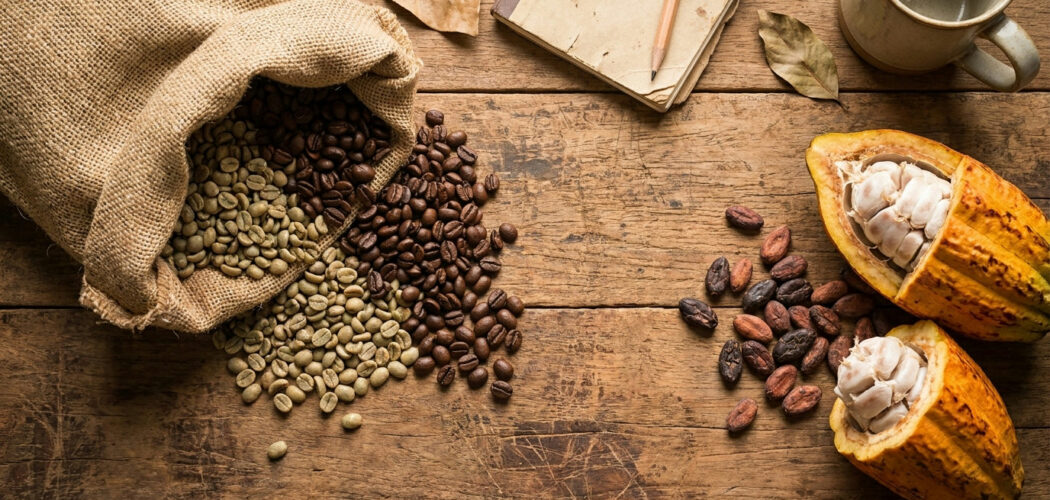
Coffee and cocoa futures are exchange contracts on two grown crops, not on metals dug from the ground. Traders group them with sugar, cotton, and similar products under the name softs. This guide explains what the two contracts are, how they differ from the drink and the chocolate bar, and which public pages describe supply. It does not tell you to trade either crop.
Arabica coffee futures listed in the United States are described by ICE on the Coffee C contract page. Contract size, the price unit, and the delivery months are printed there. Copy them from that page. This article does not freeze a size the exchange can revise. Cocoa contracts are listed by ICE as well. Open the cocoa specification beside the coffee page so the two sizes are never mixed.
What a soft commodity is
A soft commodity in this sense is a crop with a futures contract. Coffee and cocoa are tree crops. They are harvested, dried, and shipped. A futures contract is a standardized agreement to buy or sell a stated amount for a stated delivery period, under the exchange’s rules. The CFTC explains that structure in futures market basics. The crop in a sack and the contract on a screen are related, and they are not the same object.
Two coffees
Arabica and robusta are different coffees. ICE’s Coffee C contract is the U.S. benchmark people cite for arabica. Robusta has its own contract, listed in London. A headline that says only coffee has not named which one. Coffee and cocoa futures get clearer when the note says arabica, robusta, or cocoa, and names the exchange.
The contract page also describes which origins may be delivered and on what terms. Those terms are premiums and discounts set in the rulebook, not a quality ranking you invent. Read the origin list on the page you opened.
Cocoa is a different crop
Cocoa is the seed of a tropical tree, traded in its own contract. Confirm the unit on the cocoa specification rather than assuming it matches coffee. West Africa, especially Cote d’Ivoire and Ghana, is the region crop reports discuss most often for cocoa supply. The U.S. Department of Agriculture’s Foreign Agricultural Service publishes country reports and production tables: FAS. The Food and Agriculture Organization publishes international crop statistics through FAOSTAT. Use those pages for a country’s crop. Do not take a weight figure from a social post.
Weather, tree disease, and government pricing rules in the growing countries show up in those reports. They are reasons a cocoa quote can move while a coffee quote does not. Coffee and cocoa futures are a pair of markets, not one tropical price.
What moves each market
For coffee, crop reports often discuss Brazil and other arabica origins, and Vietnam and other robusta origins. Frost, drought, and disease are events only when a meteorological office or a crop agency describes them. A currency move in the producing country is a separate series. Farmer selling is a story until a trade report measures it.
For cocoa, rainfall and dry seasons in West Africa, crop disease, and official farmgate or export rules are the themes in public reports. Chocolate manufacturers publish grinding figures in their own releases. Certified stocks are the exchange’s inventory number, published by the exchange, not by a blog.
Demand for the drink and demand for chocolate are consumption stories. They are not the futures price. Put the consumption source on its own line.
How to read the two contracts
Open the coffee specification and write the name, the unit, and the listed months exactly as printed. Open the cocoa specification and do the same. Then open one quote for each, from a named screen, at a named time. Coffee and cocoa futures are understood when those four items exist: two specifications and two quotes.
A continuous chart stitches months together. The stitch is a chart choice. It is not one contract’s life. If the chart does not state the roll rule, the history is unlabeled.
A fund that says it tracks coffee or cocoa holds whatever the prospectus lists, often futures that must be rolled. Read the prospectus. Investor.gov explains fund documents and risk. Shares of a roaster or a chocolate company are company shares. They can move when the crop quote does not.
Before you pay a firm, check it in NFA BASIC.
Why these crops feel jumpy
Supply is grown in a limited set of climates, trees take years to bear, and a local weather or disease event can change a harvest that buyers were counting on. Those are reasons public reports give for large price changes. They are not a statistic this article measures. A claim that one market is the most volatile is a ranking nobody calculated here. Read the quote history you actually downloaded if you want to talk about swings, and say which contract and which years.
A smaller market can show a wider bid-ask spread than a large energy or gold contract on the same day. The spread is the pair of prices on your ticket at that time. It is not a permanent fact about softs.
A beginner’s reading list
First, the ICE coffee contract page and the ICE cocoa contract page, including size and months. Second, one USDA FAS report on coffee and one on cocoa, or the FAOSTAT item if the question is international. Third, one quote printout for each contract on the same day. Fourth, the CFTC futures guide, so the word contract means the same thing on every line.
A post that says prices reached a level not seen in decades needs the exchange settlement it refers to, the date, and the contract. Without those, it is a clipping. The CFTC note on internet hype is Understand Risks and Markets before Reacting to Internet Hype.
London and New York are both real
Arabica Coffee C is the U.S. ICE contract. Robusta trades on a London contract. Cocoa is listed in more than one center. A beginner who writes coffee and cocoa futures should name the city and the contract code on the screen. Two screens can both say cocoa and still differ by currency, unit, and delivery rule. The specification in front of you is the one that counts for that ticket.
Certified stocks in one warehouse network are not stocks in another. If a report quotes exchange stocks, name the exchange. Mixing a London stock figure with a New York price produces a sentence that cannot be checked.
What the guide leaves in your hands
You can explain arabica versus robusta, and cocoa as a third crop. You can point to ICE for the contract terms and to USDA or FAO for the crop tables. You can show two quotes taken at the same time. You cannot, from this page, say what the next harvest will be or what a contract will pay.
Health claims do not belong here. Coffee and cocoa as foods are a nutrition topic this article does not cover. A futures guide is not a diet.
Common confusions
The first confusion is one word, coffee, covering two contracts.
The second confusion is a cocoa weight treated as if it were the coffee contract’s unit. The specifications use the units they print.
The third confusion is a grocery price treated as the futures price. The grocery price includes roasting, shipping, and the shop.
The fourth confusion is a commission link in place of the ICE page.
The fifth confusion is a single softs price. Sugar and cotton are other contracts.
FAQ
What are coffee and cocoa futures?
They are exchange contracts on coffee and on cocoa, with sizes and months printed by the exchange. In the United States, ICE lists the Coffee C arabica contract and a cocoa contract.
How is robusta different?
Robusta is a different coffee with its own London contract. It is not the Coffee C arabica contract.
Why do crop reports mention West Africa for cocoa?
Because public crop tables show Cote d’Ivoire and Ghana as major producers. Read the current USDA or FAO table for the shares.
Where is the contract size?
On the ICE specification for that contract. Copy it from the page rather than from memory.
Should a beginner trade these?
This page does not say to. Learn the two specifications first. This is not financial advice.
Conclusion
Coffee and cocoa futures are two soft-commodity contracts with different crops, different units, and different growing regions. Read the ICE pages for the contract terms and the USDA or FAO pages for the harvest tables, then write down two quotes. The guide ends there. This is not financial advice. A crop note is not a trade.