

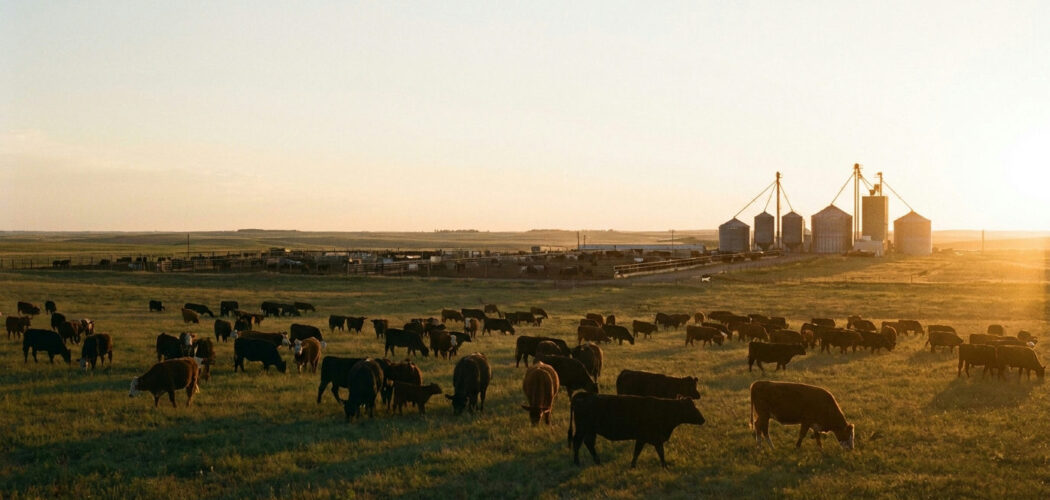
Livestock futures represent particular contracts connected with the livestock supply chain. They should not be read as interchangeable measures of every farm animal, retail meat price or producer’s profit. This beginner guide distinguishes live cattle, feeder cattle and lean hogs, explains what official agricultural reports describe, and uses fictional examples to separate contract arithmetic from a financial recommendation.
Three related markets with different meanings
The CME Group — Livestock Overview introduces CME’s live cattle, feeder cattle and lean hog contracts. Feeder cattle concern animals before the finishing stage represented by live cattle; lean hogs concern a different species and product. The overview describes physical delivery for live cattle and cash settlement for feeder cattle and lean hogs. Consult current specifications for the exact contract and delivery procedures.
That distinction matters before any price comparison. A quote for a feeder-cattle contract does not directly give the cost of a retail beef purchase. Similarly, a lean-hog futures price cannot be relabeled as the price of every live pig sold through every local channel. Keep the actual contract name beside the number throughout an explanation.
A beginner can make three separate research rows: live cattle, feeder cattle and lean hogs. Under each, record the exchange description, contract month, quotation unit, quantity and settlement method from its current documentation. Leave an unresolved field visibly blank rather than borrowing a value from a related contract because the names sound similar.
The stage of production changes the question
The CME Group — Feeder and Live Cattle Overview explains the distinction between feeder animals developing before feedlot finishing and finished animals represented by live cattle. Its discussion also identifies feed, weather and other supply-chain influences. Those relationships provide background; they do not establish a universal forecast that a change in one input will force a particular futures contract higher or lower.
When reading a story, first ask which stage it describes. Does it concern breeding inventory, feeder animals, animals on feed, slaughter, processed meat or a consumer price? A single paragraph may mention several stages, but each observation needs its own definition. Treat a relationship between them as a research question unless supporting evidence answers it.
For a fictional example, suppose one note concerns an invented feed expense while another concerns an invented sale receipt. Those are different parts of a business ledger. A change in either does not, alone, establish the firm’s profit, and neither is automatically the same as a futures price. This article supplies no actual ranch or feedlot financial case.
Futures prices and cash observations are distinct
A futures quote identifies a listed contract and month. A cash report identifies a particular observed market and reporting scope. Put those labels in separate columns. The CFTC — Futures Market Basics provides the broader explanation of futures contracts and their financial risks; it does not turn every agricultural statistic into an exchange price.
If you compare a cash observation with a futures quote, match the product definitions, units and timing before subtracting. A numerical difference between mismatched measures may look like a useful indicator while combining different animals, locations or periods. Do not present such a subtraction as an established basis measurement without explaining exactly what was compared.
A useful hypothetical worksheet uses the same invented unit for both values and labels each value’s role. For example, fictional cash 80 and fictional futures 82 differ by minus 2 when cash minus futures is the stated calculation. This arithmetic is not an actual cattle quote, trading signal or evidence of an opportunity to earn that difference.
What a cattle inventory report measures
The USDA NASS — Cattle Inventory Survey describes official estimates of the nation’s cattle herd and its components, including breeding animals, replacement animals and calves. Read the report’s observation date and coverage. A herd inventory is an agricultural estimate at a defined time, rather than a forecast of the exact future price of every related futures contract.
Be especially careful with similarly named categories. Total cattle inventory, beef cows and animals on feed do not describe the same group. Preserve the category in the sentence containing the number. A comparison made using one category should not be introduced with a broader category’s name just because that makes the headline shorter.
If you use a change from a previous period, record both periods and the comparison method. A percentage change from a year earlier answers a different question from a change since the previous month. Use the source’s stated definitions, and keep any projection distinct from an estimate concerning an already observed period.
What cattle-on-feed observations add
The USDA NASS — Cattle and Cattle on Feed Charts separates cattle-on-feed inventory, placements and marketings, with coverage labeled for feedlots of 1,000 or more capacity. These are different measures. Before quoting an edition, read its own notes and coverage rather than assuming that one chart represents every cattle operation in the country.
A stock and a flow should also remain separate. An inventory describes the amount counted at a point; a movement category concerns activity over a period. If you compare a movement with inventory, explain the calculation and the compatible definitions. Avoid describing a monthly movement figure as if it were the number of animals remaining at the end.
For a purely fictional report exercise, start with an invented inventory of 1,000 and list additions and departures as separate invented entries. The exercise can show why a single movement does not describe the whole balance. It cannot establish what happened in an actual feedlot, since no real report, complete ledger or verified animal count is supplied.
Read contract quantity before calculating dollars
A futures quote is expressed in the contract’s stated price unit. Check that unit and the contract quantity before translating a movement into money. Do not use a remembered multiplier from another livestock contract, a different product size or an old educational card when current specifications are required.
Here is fictional arithmetic unrelated to any actual exchange contract. Suppose an invented contract represents 10,000 pounds and its quotation changes by 0.50 cents per pound. Convert 0.50 cents to 0.005 dollars, then multiply by 10,000 to get 50 dollars per fictional contract before costs. The unit conversion is the lesson, not an expected gain.
Keep that amount separate from account deposit, margin requirement and maximum possible loss. A correct price-movement calculation does not describe every cost or financial exposure. Record the governing margin information separately and keep its date; this guide supplies no current requirement or recommendation about how much a reader should commit.
Settlement and expiration need specific rules
Physical delivery and cash settlement are different procedures. The educational CME overview gives their broad distinction across these contracts, but a beginner still needs the applicable current rulebook for deadlines and requirements. A contract month alone does not disclose every relevant trading, notice, delivery or settlement date.
For a non-trading comparison, write contract month in one field and the relevant documented lifecycle dates in separate fields. Add the publisher and rule version beside them. If your platform introduces additional handling deadlines, label those as provider terms instead of attributing them to the exchange without evidence.
Daily settlement and final settlement should not be combined under an ambiguous heading. Identify which calculation a source describes. Likewise, a displayed last trade, bid or ask is a distinct field. A report containing only the word price remains incomplete until the reader can tell which observation or calculation produced it.
Understand hedging without inventing results
CME’s livestock overview describes producers and buyers using these contracts to manage price risks. That is a description of purpose, not a guarantee that a particular hedge protects all costs or produces a profit. A real outcome depends on the actual exposure, instrument, timing and records, which are not supplied here.
For a hypothetical business question, distinguish an expected purchase from an expected sale and identify the relevant product and dates. Leave contract selection and transaction instructions outside this introductory exercise. Do not report that a fictitious firm achieved a successful hedge merely because the explanation sounds plausible.
An educational comparison can still be useful without a recommendation. Write what would need checking: exposure quantity, product correspondence, calendar, actual transactions, cash-market records and costs. Each missing input should remain missing, rather than be filled with favorable invented numbers to suggest verified risk reduction.
A practical beginner reading sequence
Begin with the contract description, then read the relevant USDA report definitions. Identify each number’s product, geography, date and unit. Only after those checks should you consider a comparison. This sequence turns a broad livestock headline into a specific question while keeping the limits of the available evidence visible.
Livestock futures involve financial risk. As the CFTC explains, losses on futures can exceed the initial deposit. This article is general educational information and is not financial advice, investment advice or trading advice. It recommends no contract, hedge, order or position and supplies no forecast or verified profitable strategy.
Frequently asked questions
Are feeder cattle and live cattle interchangeable?
They are related but distinct contract descriptions. Keep separate specifications and quote records rather than merging their prices.
Does a herd estimate determine a futures price?
It describes agricultural conditions within a stated scope. It does not guarantee a price path for a particular contract month.
What should I verify first?
Start with the exact livestock futures contract, quotation unit and month. Then match each supporting agricultural observation to its own definition and period.