

Disclosure: Commodities Market may earn a commission if you open an account through links on this site. Trading involves risk, and nothing here is personal financial advice.
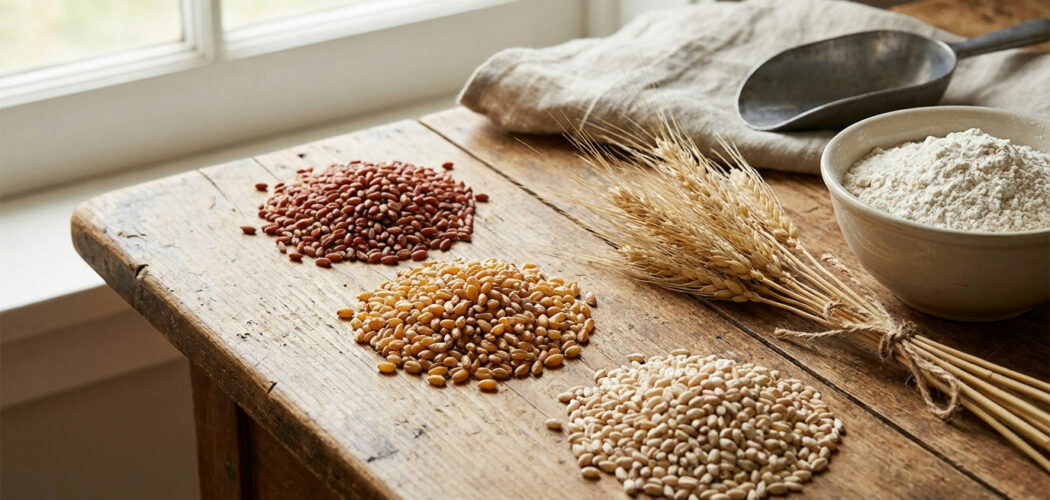
Wheat classes are the first thing to understand before following the wheat market, because “wheat” isn’t one commodity. Different classes grow in different regions, go into different foods and trade on different futures contracts. As a result, their prices don’t always move together. This guide explains the main U.S. wheat classes and what drives each one.
The main U.S. wheat classes
USDA’s wheat-sector overview distinguishes hard red winter, hard red spring, soft red winter, white and durum in its market reporting. Official grain inspection classifications can split white wheat further. The table below summarizes those broad market groups, rather than claiming that every report uses identical categories.
| Class | Main uses | Where farmers grow it (U.S.) |
|---|---|---|
| Hard red winter (HRW) | Bread and all-purpose flour | Southern and central Great Plains |
| Soft red winter (SRW) | Cakes, cookies, crackers, pastries | Eastern and southern states |
| Hard red spring (HRS) | High-protein bread flour, often blended | Northern Plains |
| White, including hard and soft types | Noodles, crackers, cereals and some breads, depending on type | Pacific Northwest and Michigan |
| Durum | Pasta and semolina | Northern Plains |
Winter vs spring wheat classes
The names refer to planting time.
- Winter wheat: farmers sow it in autumn. It lies dormant over winter, and harvest comes in summer, with timing varying by region and conditions.
- Spring wheat: by contrast, farmers sow it in spring and harvest it in late summer.
Therefore, the two face different weather risks. Winter wheat can suffer from winter kill and spring drought. Meanwhile, spring wheat faces more risk from summer heat and dryness.
Hard vs soft wheat
“Hard” and “soft” describe the kernel. Hard wheats generally contain more protein, which makes them better for bread. Soft wheats, in contrast, contain less protein and suit cakes and pastries. Protein content is a key quality factor, and a buyer may pay a protein premium when that quality is needed. Compare the actual specification rather than assuming a class name guarantees a protein level.
Wheat futures by class
Several U.S. futures contracts track different classes:
- Chicago (CBOT): soft red winter wheat futures trade here, as part of CME Group. Check the ticker and delivery month when a report uses the general label “wheat.”
- Kansas City origin: hard red winter wheat futures, which started in Kansas City, also trade through CME Group.
- Hard red spring: older market references may use the name Minneapolis. Contract listings and venues can change; verify the exchange and current specifications before using a quote.
Because each contract reflects a different class and growing region, the price gaps between them, called spreads, can change with weather and quality conditions.
What moves wheat prices
- Weather in the U.S. and in major exporting countries such as Russia, the EU, Canada, Australia and Argentina.
- Global supply and demand, which the USDA tracks in its monthly WASDE report covering U.S. and world wheat.
- Export competition and trade policy, including export restrictions by major producers.
- Geopolitics, especially events affecting Black Sea exports.
- Quality and protein levels in each year’s crop.
- The U.S. dollar, which affects export competitiveness.
Why wheat classes matter for investors
If you buy a “wheat” ETF or follow “wheat prices” in the news, check which class and contract it refers to. In fact, a drought in the Southern Plains may hit hard red winter wheat far harder than soft red winter.
Wheat futures carry leverage and can swing sharply. For more on crop markets, see our guide to agriculture commodities trading.
Class, grade and protein answer different questions
A class name identifies a type of wheat. A grade and an inspection result tell you more about the particular lot. Protein content is another measurement, not a replacement for either. USDA’s Grain Grading Primer explains the inspection framework and official classes. For a transaction, use the actual certificate and buyer specification, not a photograph or a broad description such as “bread wheat.”
For example, a miller evaluating two lots of the same class could still receive different quality reports. The useful questions are whether each lot meets the requested specification, how the quoted premium or discount is calculated, and whether delivery terms match. This is why a futures benchmark cannot tell you the complete delivered cost of flour or the price a particular farmer receives.
A worked example of a wheat-class spread
Suppose, purely for illustration, a winter-wheat contract is quoted at 600 cents per bushel and another class at 650 cents for the same delivery month. The second-minus-first spread is 50 cents per bushel. These are invented prices, not current market quotations. Recording the sign convention matters: another chart might display the first contract minus the second, producing minus 50 for the same two quotes.
Now imagine the second rises to 680 while the first stays at 600. The spread widens to 80 cents. That tells you which quoted class outperformed over the observation period; it does not prove that weather, protein demand or export buying caused the change. Investigate a possible explanation against reports for the relevant crop region and marketing year.
Before comparing live quotes, check that they use the same currency, unit, observation time and contract month. If one is an old last trade from a quiet contract, a displayed spread may not be executable. Also distinguish this comparison between classes from a calendar spread between two delivery months of the same class.
Build a report routine around the class you follow
Start with the USDA WASDE report for the wider supply-and-use picture. Then use the ERS wheat reports and data for more detailed context. Read the table heading and footnotes: a total wheat figure and a by-class figure answer different questions. Keep the report’s publication date separate from the marketing year it describes.
A useful reading sheet has columns for the report date, wheat class, geographic scope, measure, previous estimate and revised estimate. Add a note explaining whether you are looking at acreage, yield, production, use or stocks. Without those labels it is easy to treat a revision to expected production as if it were a change to existing inventories.
When reading weather news, locate the affected growing region and identify which crop is in the ground. “U.S. drought” is too broad to establish a class-specific effect. Then separate the reported condition from the price implication: a weather problem does not mechanically determine the next price move, because expectations and other sources of supply matter too.
Check the exchange contract before interpreting exposure
CME’s wheat product overview identifies Chicago soft red winter and Kansas City hard red winter contracts. Its hard red spring FAQ also illustrates why current product documents matter. An older guide listing only familiar venue names may omit later listings or rule changes.
For the exact product, check the delivery grade, allowable substitutions or differentials, delivery locations, trading hours and contract calendar. Those terms determine the exposure. If a fund holds several wheat futures months, its returns also reflect that mix, its rolling rules and expenses; the class name alone is insufficient.
A checklist for reading a wheat-price headline
- Which wheat class, exchange and delivery month does the price describe?
- Is the quotation futures, a local cash bid, an export offer or a retail product price?
- Do both sides of any comparison use the same unit and timestamp?
- Does the claimed weather or quality issue concern this class and crop region?
- Is a cited USDA number total wheat or a specific class, and what period does it cover?
- Does the report state an observed fact, an estimate or an interpretation?
These questions make a wheat-market note more precise without turning it into a buy or sell signal. They are particularly useful when a headline moves between U.S. crop conditions and world wheat totals in the same paragraph.
Frequently asked questions
Which wheat goes into bread?
Mainly hard wheats, such as hard red winter and hard red spring, because of their higher protein content.
Why do different wheat futures prices differ?
They reflect different classes, qualities and growing regions, each with its own supply and demand.
When do U.S. farmers harvest winter wheat?
In summer following autumn planting, with the schedule varying by growing region and conditions.
Follow the specific wheat market
Wheat classes connect crop characteristics, end uses and price references. Identify the class first, then check quality, location, contract month and the scope of any report you read. That sequence helps you compare relevant information and avoid treating every wheat quotation as the same exposure.
Trading commodities involves risk. Past performance does not guarantee future results. This article is for education only and is not financial advice.