

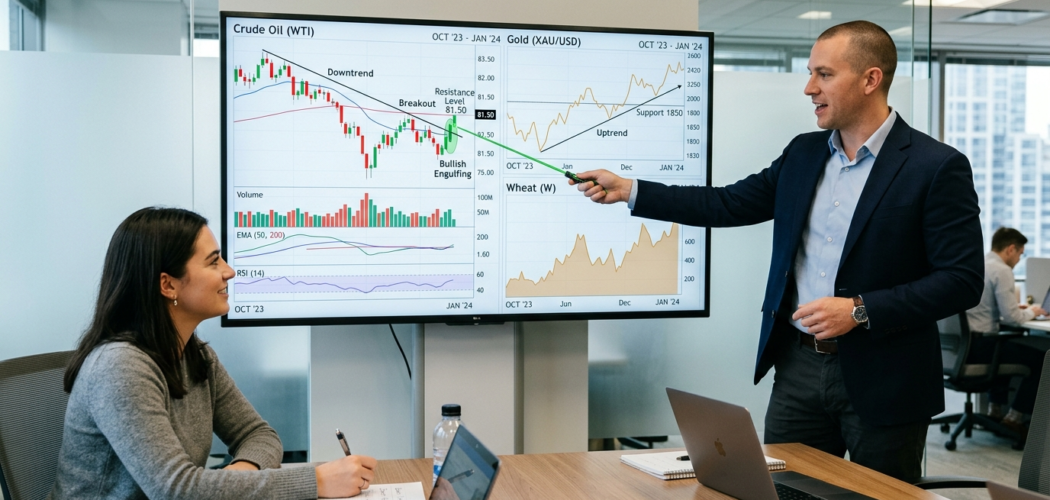
Learning how to use charts commodity prices is one of the most valuable skills you can develop as a trader or investor. Commodity markets move quickly, and without a clear visual framework, it becomes difficult to interpret price behavior. Charts provide that framework, allowing you to see patterns, trends, and shifts that are not obvious from raw numbers alone.
At the same time, many beginners feel overwhelmed when they first encounter charts. However, once you understand the basics, charts become a powerful tool rather than a confusing obstacle. When you use charts commodity prices consistently, you begin to recognize how markets react to events and how trends develop over time. This understanding gives you a strong advantage when making decisions.
Why Charts Matter in Commodity Trading
To effectively use charts commodity prices, you need to understand why charts are so important. Charts transform complex data into visual information that is easier to analyze. Instead of reading numbers, you can see how prices move over time.
For example, a chart can quickly show whether a commodity is trending upward, downward, or moving sideways. This insight helps you decide whether to buy, sell, or wait. In addition, charts highlight key levels where prices often react, such as support and resistance.
Moreover, charts allow you to compare past behavior with current conditions. By doing so, you can identify recurring patterns. These patterns often provide clues about potential future movements. As a result, using charts improves both your understanding and your confidence.
Understanding Basic Chart Types
When you start to use charts commodity prices, choosing the right chart type is essential. Different chart types present data in different ways, and each has its advantages. The most common types include line charts, bar charts, and candlestick charts.
Line charts are the simplest. They connect closing prices over time, making them easy to read. Because of this simplicity, they are ideal for beginners. However, they provide limited information compared to other chart types.
Bar charts offer more detail by showing opening, closing, high, and low prices. This additional information helps you understand price ranges within a specific period. As a result, you gain a clearer view of market activity.
Candlestick charts are the most popular among traders. They display the same data as bar charts but in a more visual format. Each candlestick shows price movement clearly, making it easier to spot trends and reversals. Therefore, many traders prefer this format when analyzing commodity markets.
Identifying Trends in Price Movements
One of the main reasons to use charts commodity prices is to identify trends. A trend shows the general direction of the market over time. Recognizing trends helps you align your strategy with market momentum.
An upward trend is characterized by higher highs and higher lows. This pattern indicates that buyers are in control. Conversely, a downward trend shows lower highs and lower lows, suggesting that sellers dominate.
Sideways trends occur when prices move within a range. During these periods, the market lacks a clear direction. Understanding these conditions helps you avoid unnecessary trades.
By learning to identify trends, you can make more informed decisions. Instead of guessing, you base your actions on observable patterns.
Using Support and Resistance Levels
Support and resistance levels are key concepts when you use charts commodity prices. These levels represent areas where prices tend to stop or reverse. Understanding them can significantly improve your timing.
Support is a level where buying interest prevents prices from falling further. Resistance, on the other hand, is where selling pressure limits upward movement. These levels often act as psychological barriers in the market.
When prices approach support, traders look for buying opportunities. Similarly, when prices reach resistance, they may consider selling. By recognizing these levels, you can plan your trades more effectively.
In addition, breakouts occur when prices move beyond support or resistance. These movements often signal strong trends. Therefore, paying attention to these levels helps you anticipate significant changes.
Reading Volume for Confirmation
Volume is another important factor when you use charts commodity prices. It shows the number of contracts or trades executed during a specific period. High volume often indicates strong interest in the market.
When prices rise with high volume, the trend is usually more reliable. Conversely, low volume may suggest weak momentum. Therefore, volume acts as a confirmation tool for price movements.
For example, if a breakout occurs with high volume, it is more likely to continue. However, if volume is low, the breakout may fail. By combining price action with volume analysis, you gain a more complete understanding of the market.
Combining Technical Indicators Wisely
To enhance your ability to use charts commodity prices, technical indicators can provide additional insights. Indicators such as moving averages, RSI, and MACD help analyze trends and momentum.
Moving averages smooth out price data, making trends easier to identify. For instance, a rising moving average indicates an upward trend. On the other hand, a falling average suggests a downward trend.
The Relative Strength Index (RSI) measures whether a commodity is overbought or oversold. This information helps you identify potential reversals. Similarly, MACD shows changes in momentum, which can signal trend shifts.
However, it is important not to rely on too many indicators. Using too many tools can create confusion. Instead, focus on a few reliable indicators that complement your strategy.
Avoiding Common Charting Mistakes
While learning to use charts commodity prices, it is important to avoid common mistakes. One of the biggest errors is overcomplicating your charts. Adding too many indicators or drawing excessive lines can make analysis difficult.
Another mistake is ignoring the bigger picture. Focusing only on short-term charts can lead to misleading conclusions. Therefore, always consider multiple timeframes to gain a broader perspective.
Emotional trading is also a challenge. Reacting impulsively to chart movements often leads to poor decisions. Instead, follow a structured approach based on your analysis.
Additionally, relying solely on charts without considering market fundamentals can limit your understanding. Combining both approaches provides a more balanced view.
Developing a Consistent Charting Routine
Consistency is key when you use charts commodity prices. Regular analysis helps you become familiar with market behavior. Over time, patterns become easier to recognize.
A daily routine might include reviewing charts, identifying trends, and noting key levels. This process keeps you informed and prepared. In addition, keeping a record of your observations helps track your progress.
By maintaining consistency, you build confidence in your analysis. This confidence allows you to make decisions more effectively and with less hesitation.
Using Charts for Better Decision-Making
Ultimately, the goal of learning to use charts commodity prices is to improve decision-making. Charts provide the information needed to evaluate opportunities and manage risk.
By analyzing trends, levels, and indicators, you can identify high-probability setups. This approach reduces guesswork and increases accuracy. As a result, your trading becomes more disciplined.
Moreover, charts help you manage risk by identifying exit points. Knowing when to exit a trade is just as important as knowing when to enter. This balance is essential for long-term success.
Conclusion
Learning how to use charts commodity prices is a skill that can transform your approach to trading and investing. By turning complex data into clear visual insights, charts allow you to understand market behavior more effectively. This understanding helps you identify trends, manage risk, and make informed decisions.
At the same time, success requires practice and consistency. By focusing on simple techniques and avoiding unnecessary complexity, you can build a strong foundation. Over time, charts become an essential tool that supports confident and disciplined trading. Ultimately, those who master chart analysis are better equipped to navigate the ever-changing world of commodity markets.
FAQ
- What is the best chart type for beginners?
Candlestick charts are widely recommended because they provide detailed information in a clear visual format. - How often should I analyze charts?
Daily analysis is ideal, but consistency matters more than frequency. - Do charts guarantee accurate predictions?
No, charts provide insights, but markets can still be unpredictable. - Can I trade using charts alone?
Charts are important, but combining them with fundamental analysis improves results. - What is the biggest mistake in chart analysis?
Overcomplicating charts with too many indicators often leads to confusion and poor decisions.